
This post is also available in:
 Deutsch (German)
  Français (French)
  Italiano (Italian)
  Español (Spanish)
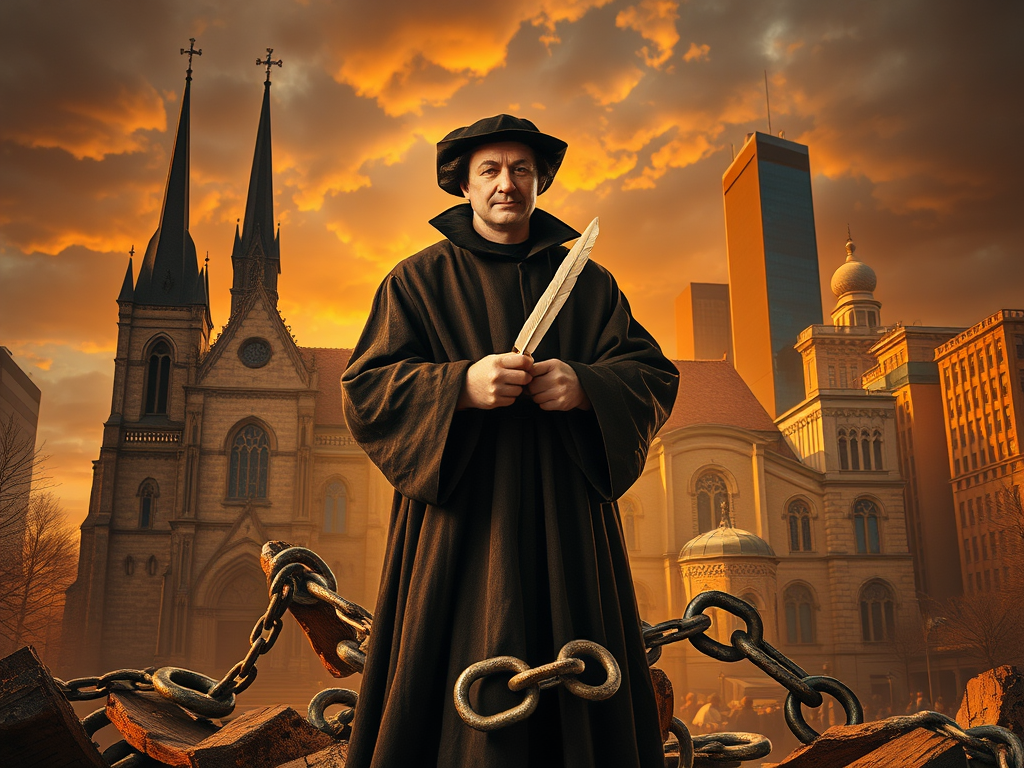
The common basis of Martin Luther’s 95 Theses and the We2030 movement lies at the heart of both initiatives:
Exposing grievances, exposing abuses of power and giving people back their dignity, responsibility and freedom.
What Martin Luther wanted with his 95 theses (briefly summarized):
Martin Luther did not want to destroy the church, but to lead it back to its true mission.
His 95 theses (1517) were directed against:
- the abuse of religious power (especially through the sale of indulgences),
- the instrumentalization of faith for the benefit of political and economic interests,
- the obscuring of truth through authority,
- the incapacitation of the individual, who was not allowed to think, believe and understand for himself.
The aim was a reform from within that placed people at the center:
With conscience, knowledge and responsibility before God – not as mere objects of ecclesiastical or secular power.
What Wir2030 wants to achieve (briefly summarized):
We2030 strives for peaceful change – away from a technocratically controlled society towards an order in which:
- Freedom and self-determination are inviolable,
- Power is limited and controlled,
- Truth is created through discourse, not censorship,
- people as subjects are once again allowed to think, decide and take responsibility for themselves.
This is also about a reformation – but this time of society, politics and science, at a time when economic interests, moral pressure and media manipulation are threatening the freedom of the individual.
Common basis of Luther 1517 and We2030 today:
| Aspect | Martin Luther (1517) | We2030 (today) |
| Goal | Reformation of the church | Reformation of politics, science & society |
| Opponent | Abuse of power by church & clergy | Abuse of power by the state, corporations & ideology |
| Point of criticism | Indulgences, obedience to authority, incapacitation | Surveillance, coercion, opinion control, incapacitation |
| Principle | Conscience, truth, personal responsibility | Freedom, truth, personal responsibility |
| Method | Word, argument, open debate | Word, argument, open debate |
| Risk | Exclusion, persecution, defamation | Exclusion, persecution, defamation |
| Hope | Return to the truth & the dignity of the individual | Return to freedom, justice & dignity of the individual |
Conclusion
We2030 is the spirit of Wittenberg – in a new age.
Just as Luther stood up against the morally disguised power of the church, We2030 opposes the morally legitimized encroachment of the state and the global elites.
Both demand: Man is free. And no one has the right to take this freedom away from him in the name of “justice”.

Leave a Reply